61. A sonometer wire when vibrated in full length has frequency $$n.$$ Now, it is divided by the help of bridges into a number of segments of lengths $${l_1},{l_2},{l_3},\,....$$ When vibrated these segments have frequencies $${n_1},{n_2},{n_3},\,....$$ Then, the correct relation is
A
$$n = {n_1} + {n_2} + {n_3} + ....$$
B
$${n^2} = n_1^2 + n_2^2 + n_3^2 + \,....$$
C
$$\frac{1}{n} = \frac{1}{{{n_1}}} + \frac{1}{{{n_2}}} + \frac{1}{{{n_3}}} + \,.....$$
D
$$\frac{1}{{\sqrt n }} = \frac{1}{{\sqrt {{n_1}} }} + \frac{1}{{\sqrt {{n_2}} }} + \frac{1}{{\sqrt {{n_3}} }} + \,.....$$
Answer :
$$\frac{1}{n} = \frac{1}{{{n_1}}} + \frac{1}{{{n_2}}} + \frac{1}{{{n_3}}} + \,.....$$
62. In a plane progressive harmonic wave particle speed is always less than the wave speed if
A
amplitude of wave is less than $$\frac{\lambda }{{2\pi }}$$
B
amplitude of wave is greater than $$\frac{\lambda }{{2\pi }}$$
C
amplitude of wave is less than $$\lambda $$
D
amplitude of wave is greater than $$\frac{\lambda }{{\pi }}$$
Answer :
amplitude of wave is less than $$\frac{\lambda }{{2\pi }}$$
63. An earthquake generates both transverse $$\left( S \right)$$ and longitudinal $$\left( P \right)$$ sound waves in the earth. The speed of $$S$$ waves in about $$4.5\,km/s$$ and that of $$P$$ waves is about $$8.0\,km/s.$$ A seismograph records $$P$$ and $$S$$ waves from an earthquake. The first $$P$$ wave arrives $$4.0\,min.$$ before the first $$S$$ wave. The epicenter of the earthquake is located at a distance about
A
$$25\,km$$
B
$$250\,km$$
C
$$2500\,km$$
D
$$5000\,km$$
Answer :
$$2500\,km$$
64.
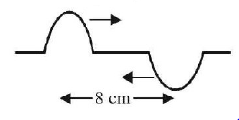
Two pulses in a stretched string whose centres are initially $$8\,cm$$ apart are moving towards each other as shown in the figure. The speed of each pulse is $$2\,cm/s.$$ After $$2\,s,$$ the total energy of the pulses will be
A
Zero
B
Purely kinetic
C
Purely potential
D
Partly kinetic and partly potential
Answer :
Purely kinetic
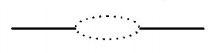
65. An observer moves towards a stationary source of sound, with a velocity one-fifth of the velocity of sound. What is the percentage increase in the apparent frequency ?
A
$$0.5\%$$
B
zero
C
$$20\% $$
D
$$5\% $$
Answer :
$$20\% $$
66. A closed organ pipe (closed at one end) is excited to support the third overtone. It is found that air in the pipe has
A
three nodes and three antinodes
B
three nodes and four antinodes
C
four nodes and three antinodes
D
four nodes and four antinodes
Answer :
four nodes and four antinodes
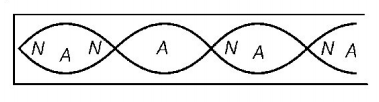
67. Two vibrating strings of the same material but lengths $$L$$ and $$2\,L$$ have radii $$2\,r$$ and $$r$$ respectively. They are stretched under the same tension. Both the strings vibrate in their fundamental nodes, the one of length $$L$$ with frequency $${{v_1}}$$ and the other with frequency $${{v_2}}.$$ The raio $$\frac{{{v_1}}}{{{v_2}}}$$ is given by
A
2
B
4
C
8
D
1
Answer :
1
68.
The displacement $$y$$ of particle in a medium can be expressed as,
$$y = {10^{ - 6}}\sin \left( {100t + 20x + \frac{\pi }{4}} \right)m$$ where $$t$$ is in second and $$x$$ in meter. The speed of the wave is
A
$$20\,m/s$$
B
$$5\,m/s$$
C
$$2000\,m/s$$
D
$$5\pi \,m/s$$
Answer :
$$5\,m/s$$
69. The length of the wire between two ends of a sonometer is $$100\,cm.$$ What should be the positions of two bridges below the wire so that the three segments of the wire have their fundamental frequencies in the ratio of $$1 : 3 : 5$$ ?
A
$$\frac{{1500}}{{23}}cm,\frac{{2000}}{{23}}cm$$
B
$$\frac{{1500}}{{23}}cm,\frac{{500}}{{23}}cm$$
C
$$\frac{{1500}}{{23}}cm,\frac{{300}}{{23}}cm$$
D
$$\frac{{300}}{{23}}cm,\frac{{1500}}{{23}}cm$$
Answer :
$$\frac{{1500}}{{23}}cm,\frac{{2000}}{{23}}cm$$
70. Length of a sonometer wire between two fixed ends is $$110\,cm.$$ If the fundamental frequencies are in the ratio of $$1 : 2 : 3,$$ then what is the ratio of lengths of these segments of the wire?
A
$$3 : 2 : 1$$
B
$$6 : 3 : 2$$
C
$$6 : 2 : 3$$
D
$$2 : 3 : 6$$
Answer :
$$6 : 3 : 2$$