121. Which one of the following is a peptide hormone?
A
Glucagon
B
Testosterone
C
Thyroxin
D
Adrenaline
Answer :
Glucagon
122. The glycosidic linkage involved in linking the glucose units in amylose part of starch is
A
$${C_1}{\text{ - }}{C_4}\,\,\beta {\text{ - linkage}}$$
B
$${C_1}{\text{ - }}{C_6}\,\,\beta {\text{ - linkage}}$$
C
$${C_1}{\text{ - }}{C_6}\,\,\alpha {\text{ - linkage}}$$
D
$${C_1}{\text{ - }}{C_4}\,\,\alpha {\text{ - linkage}}$$
Answer :
$${C_1}{\text{ - }}{C_4}\,\,\alpha {\text{ - linkage}}$$
123.
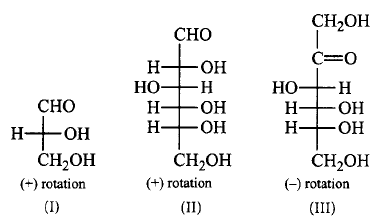
Optical rotations of some compounds along with their structures are given below. Which of them have $$D$$ - configuration?
A
I, II, III
B
II, III
C
I, II
D
III
Answer :
I, II, III
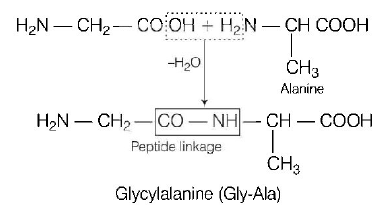
124. In a protein molecule various amino acids are linked together by
A
$$\beta $$ - glycosidic bond
B
peptide bond
C
dative bond
D
$$\alpha $$ - glycosidic bond
Answer :
peptide bond
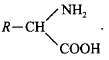
125. Which of the following statements is not correct?
A
Proteins are polyamides formed from amino acids.
B
Except glycine, all other amino acids show optical activity.
C
Natural proteins are commonly made up of $$L$$ - isomer of amino acids.
D
In $$\alpha $$ - amino acids, $$ - N{H_2}$$ and $$ - COOH$$ groups are attached to different carbon atoms.
Answer :
In $$\alpha $$ - amino acids, $$ - N{H_2}$$ and $$ - COOH$$ groups are attached to different carbon atoms.
126. Complete hydrolysis of starch gives :
A
glucose only
B
galactose and fructose in equimolar amounts
C
glucose and galactose in equimolar amounts
D
glucose and fructose in equimolar amounts
Answer :
glucose only
127. Proteins are found to have two different types of secondary structures viz. $$\alpha $$ - helix and $$\beta $$ - pleated sheet structure. $$\alpha $$ - helix structure of protein is stabilised by
A
peptide bonds
B
van der Waalsforces
C
hydrogen bonds
D
dipole-dipole interactions
Answer :
hydrogen bonds
 group of another amino acid residue.
 128. When $$\alpha {\text{ - }}D{\text{ - }}$$ glucose and $$\beta {\text{ - }}D{\text{ - }}$$ glucose are dissolved in water in two separate beakers I and II respectively and allowed to stand, then –
A
specific rotation in beaker I will decrease while in II will increase upto a constant value
B
the specific rotation of equilibrium mixture in two beakers will be different
C
the equilibrium mixture in both beakers will be leavorotatory
D
the equilibrium mixture in both beakers will contain only cyclic form of glucose
Answer :
specific rotation in beaker I will decrease while in II will increase upto a constant value
129. Each polypeptide in a protein has amino acids linked with each other in a specific sequence. This sequence of amino acids is said to be _________.
A
primary structure of proteins
B
secondary structure of proteins
C
tertiary structure of proteins
D
quaternary structure of proteins
Answer :
primary structure of proteins
130. When adenine is attached to ribose sugar, it is called adenosine. To make a nucleotide from it, would require
A
oxygenation
B
addition of a base
C
addition of phosphate
D
hydrogenation
Answer :
addition of phosphate