Alternating Current MCQ Questions & Answers in Electrostatics and Magnetism | Physics
Learn Alternating Current MCQ questions & answers in Electrostatics and Magnetism are available for students perparing for IIT-JEE, NEET, Engineering and Medical Enternace exam.
61.
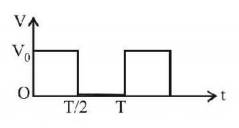
The $$r.m.s.$$ value of potential difference $$V$$ shown in the figure is
62.
In an $$AC$$ circuit with voltage $$V$$ and current $$i$$ the power dissipated is
A
Depends on the phase between $$V$$ and $$i$$
B
$$\frac{1}{{\sqrt 2 }}Vi$$
C
$$\frac{1}{2}Vi$$
D
$$Vi$$
Answer :
Depends on the phase between $$V$$ and $$i$$
In an $$AC$$ circuit with voltage $$V$$ and current $$i,$$ the power dissipated is given by
$$P = Vi\cos \phi $$
where, $$\phi $$ is the phase and $$\cos \phi $$ is the power factor. Thus, the power dissipated, depends upon the phase between voltage $$V$$ and current $$i.$$
63.
In a $$LCR$$ circuit capacitance is changed from $$C$$ to $$2 C.$$ For the resonant frequency to remain unchanged, the inductance should be changed from $$L$$ to
A
$$\frac{L}{2}$$
B
$$2L$$
C
$$4L$$
D
$$\frac{L}{4}$$
Answer :
$$\frac{L}{2}$$
For resonant frequency to remain same
$$LC$$ should be const. $$LC$$ = const
$$ \Rightarrow LC = L' \times 2C \Rightarrow L' = \frac{L}{2}$$
64.
A fully charged capacitor $$C$$ with initial charge $${q_0}$$ is connected to a coil of self inductance $$L$$ at $$t = 0.$$ The time at which the energy is stored equally between the electric and the magnetic fields is:
A
$$\frac{\pi }{4}\sqrt {LC} $$
B
$$2\pi \sqrt {LC} $$
C
$$\sqrt {LC} $$
D
$$\pi \sqrt {LC} $$
Answer :
$$\frac{\pi }{4}\sqrt {LC} $$
Energy stored in magnetic field $$ = \frac{1}{2}L{i^2}$$
Energy stored in electric field $$ = \frac{1}{2}\frac{{{q^2}}}{C}$$
$$\therefore \frac{1}{2}L{i^2} = \frac{1}{2}\frac{{{q^2}}}{C}$$
$${\text{Also}}\,q = {q_0}\cos \omega t\,{\text{and}}\,\omega = \frac{1}{{\sqrt {LC} }}$$
On solving $$t = \frac{\pi }{4}\sqrt {LC} $$
65.
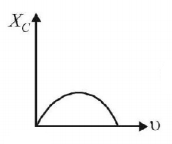
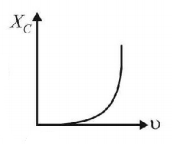
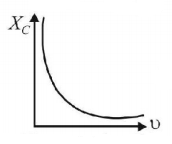
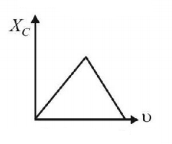
Which of the following graphs represents the correct variation of capacitive reactance $${X_C}$$ with frequency $$\upsilon $$ ?
A
B
C
D
Answer :
Capacitive reactance, $${X_C} = \frac{1}{{\omega C}} = \frac{1}{{2\pi \upsilon C}}$$
$$ \Rightarrow {X_L} \propto \frac{1}{\upsilon }$$
With increases in frequency, $${X_C}$$ decreases. Hence, option (C) represents the correct graph.
66.
The self inductance of the motor of an electric fan is $$10 H.$$ In order to impart maximum power at $$50 Hz,$$ it should be connected to a capacitance of
A
$$8\mu F$$
B
$$4\mu F$$
C
$$2\mu F$$
D
$$1\mu F$$
Answer :
$$1\mu F$$
For maximum power, $${X_L} = {X_C},$$ which yields
$$\eqalign{
& C = \frac{1}{{{{\left( {2\pi n} \right)}^2}L}} = \frac{1}{{4{\pi ^2} \times 50 \times 50 \times 10}} \cr
& \therefore C = 0.1 \times {10^{ - 5}}F = 1\mu F \cr} $$
67.
If an $$LCR$$ series circuit is connected to an $$ac$$ source, then at resonance the
A
voltage across $$R$$ is zero
B
voltage across $$R$$ equals the applied voltage
C
voltage across $$C$$ is zero
D
voltage across $$L$$ equals the applied voltage
Answer :
voltage across $$R$$ equals the applied voltage
In series $$RLC$$ circuit,
Voltage, $$V = \sqrt {V_R^2 + {{\left( {{V_L} - {V_C}} \right)}^2}} $$
And, at resonance, $${V_L} = {V_C}$$
Hence, $$V = {V_R}$$
68.
In an experiment, $$200\,V\,AC$$ is applied at the ends of an $$LCR$$ circuit. The circuit consists of an inductive reactance
$$\left( {{X_L}} \right) = 50\,\Omega ,$$ capacitive reactance
$$\left( {{X_C}} \right) = 50\,\Omega $$ and ohmic resistance
$$\left( R \right) = 10\,\Omega .$$ The impedance of the circuit is
A
$$10\,\Omega $$
B
$$20\,\Omega $$
C
$$30\,\Omega $$
D
$$40\,\Omega $$
Answer :
$$10\,\Omega $$
Total effective resistance of $$LCR$$ circuit is called impedance of the $$LCR$$ series circuit. It is represented by $$Z.$$
where $$Z = \frac{{{V_0}}}{{{i_0}}} = \sqrt {{R^2} + {{\left( {{X_L} - {X_C}} \right)}^2}} $$
Given, $${V_{AC}} = 200\,V$$
Resistance offered by inductor $${X_L} = 50\,\Omega $$
Resistance offered by capacitance $${X_C} = 50\,\Omega $$
$$\eqalign{
& R = 10\,\Omega \cr
& Z = ? \cr
& \therefore Z = \sqrt {{{\left( {10} \right)}^2} + {{\left( {50 - 50} \right)}^2}} \cr
& {\text{or}}\,\,Z = 10\,\Omega \cr} $$
69.
The core of a transformer is laminated because
A
energy losses due to eddy currents may be minimised
B
the weight of the transformer may be reduced
C
rusting of the core may be prevented
D
ratio of voltage in primary and secondary may be increased
Answer :
energy losses due to eddy currents may be minimised
When magnetic flux linked with a coil changes, induced emf is produced in it and the induced current flows through the wire forming the coil. In 1895, Focault experimentally found that these induced currents are set up in the conductor in the form of closed loops. These currents look like eddies or whirlpools and likewise are known as eddy curents. They are also known as Focault’s current. These currents oppose the cause of their origin, therefore, due to eddy currents, a great amount of energy is wasted in form of heat energy. If core of transformer is laminated, then their effect can be minimised.
70.
In an $$AC$$ circuit an alternating voltage $$e = 200\sqrt 2 \sin 100t\,volt$$ is connected to a capacitor of capacity $$1\,\mu F.$$ The $$rms$$ value of the current in the circuit is
A
$$100\,mA$$
B
$$200\,mA$$
C
$$20\,mA$$
D
$$10\,mA$$
Answer :
$$20\,mA$$
Problem Solving Strategy
Compare the given equation with the equation of alternating voltage i.e. $$e = {e_m}\sin \omega t$$
where, $${e_m} = {e_{rms}}$$
Given,
emf, $$e = 200\sqrt 2 \sin 100\,t$$
and $$C = 1\mu F = 1 \times {10^{ - 6}}F$$
As $${e_{rms}} = 200\,V\,{\text{and}}\,\omega = 100$$
$$\eqalign{
& \therefore {X_C} = \frac{1}{{\omega C}} = \frac{1}{{1 \times {{10}^{ - 6}} \times 100}} = {10^4}\,\Omega \cr
& {i_{rms}} = \frac{{{e_{rms}}}}{{{X_C}}} = \frac{{200}}{{{{10}^4}}} = 2 \times {10^{ - 2}}A = 20\,mA \cr} $$