101. Which of the following reactions is not of the first order?
A
Inversion of sucrose in the presence of acid
B
Acid-catalyzed hydrolysis of ethyl acetate
C
Hydrolysis of tertiary butyl halide using alkali
D
Oxidation of $${I^ - }\,ion$$ by $${S_2}O_8^{2 - }\,ion$$
Answer :
Oxidation of $${I^ - }\,ion$$ by $${S_2}O_8^{2 - }\,ion$$
102. A plot of $$\log \left( {a - x} \right)$$ against time $$t$$ is a straight line. This indicates that the reaction is of
A
zero order
B
first order
C
second order
D
third order
Answer :
first order
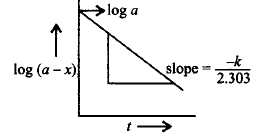
103. In a first order reaction, the concentration of reactant is reduced to $$\frac{1}{8}$$ of the initial concentration in 75 minutes at $$298\,K.$$ What is the half-life period of the reaction in minutes?
A
$$50\,\min .$$
B
$$15\,\min .$$
C
$$30\,\min .$$
D
$$25\,\min .$$
Answer :
$$25\,\min .$$
104.
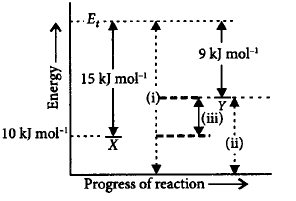
In a hypothetical reaction $$X \to Y,$$ the activation energy for the forward and backward reactions are $$15$$ and $$9\,kJ\,mo{l^{ - 1}}$$ respectively. The potential energy of $$X$$ is $$10\,kJ\,mo{l^{ - 1}}.$$ Which of the following statements is/are correct?
(i) The threshold energy of the reaction is $$25\,kJ\,mo{l^{ - 1}}.$$
(ii) The potential energy of $$Y$$ is $$16\,kJ\,mo{l^{ - 1}}.$$
(iii) Heat of reaction is $$6\,kJ\,mo{l^{ - 1}}.$$
(iv) The reaction is endothermic.
A
Only (i)
B
Only (i) and (ii)
C
Only (ii) and (iii)
D
All are correct
Answer :
All are correct
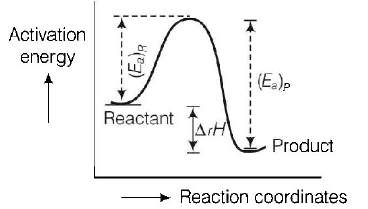
105. For exothermic reaction, the energy of activation of the reactants is
A
equal to the energy of activation of products
B
less than the energy of activation of products
C
greater than the energy of activation of products
D
sometimes greater and sometimes less than that of the products
Answer :
less than the energy of activation of products
106. In the reaction $$A \to B + C,$$ rate constant is $$0.001\,M{s^{ - 1}}.$$ If we start with $$1\,M$$ of $$A$$ then $$conc.$$ of $$A$$ and $$B$$ after 10 minuter are respectively.
A
$$0.5\,M,0.5\,M$$
B
$$0.6\,M,0.4\,M$$
C
$$0.4\,M,0.6\,M$$
D
$$0.6\,M\,0.5\,M$$
Answer :
$$0.4\,M,0.6\,M$$
107. In the transformation of $$_{92}^{238}U$$ to $$_{92}^{234}U$$ , if one emission is an $$\alpha - $$ particle, what should be the other emission(s) ?
A
one $${\beta ^ - }$$ and one $$\gamma $$
B
one $${\beta ^ + }$$ and one $${\beta ^ - }$$
C
two $${\beta ^ - }$$
D
two $${\beta ^ - }$$ and one $${\beta ^ + }$$
Answer :
two $${\beta ^ - }$$
108.
The following mechanism has been proposed for the reaction of $$NO$$ with $$B{r_2}$$ to form $$NOBr$$ :
$$\eqalign{
& NO\left( g \right) + B{r_2}\left( g \right) \rightleftharpoons NOB{r_2}\left( g \right) \cr
& NOB{r_2}\left( g \right) + NO\left( g \right) \to 2NOBr\left( g \right) \cr} $$
If the second step is the rate determining step, the order of the reaction with respect to $$NO\left( g \right)$$ is
A
3
B
2
C
1
D
0
Answer :
2
109. Which of the following statements is not correct for the catalyst?
A
It catalyses the forward and backward reaction to the same extent.
B
It alters $$\Delta G$$ of the reaction.
C
It is a substance that does not change the equilibrium constant of a reaction.
D
It provides an alternate mechanism by reducing activation energy between reactants and products.
Answer :
It alters $$\Delta G$$ of the reaction.
110.
In acidic medium, the rate of reaction between $$\left[ {BrO_3^ - } \right]$$ and $$\left[ {B{r^ - }} \right]$$ ions is given by the expression $$ - \frac{{d\left[ {BrO_3^ - } \right]}}{{dt}}$$ $$ = k\left[ {BrO_3^ - } \right]\left[ {B{r^ - }} \right]{\left[ {{H^ + }} \right]^2}$$
It means
(i) rate constant of the reaction depends upon the concentration of $${H^ + }$$ ions
(ii) rate of reaction is independent of the concentration of acid added
(iii) the change in $$pH$$ of the solution will affect the rate of reaction
(iv) doubling the concentration of $${{H^ + }}$$ ions will increase the reactions rate by 4 times.
A
Only (ii)
B
Only (iii)
C
Only (i) and (ii)
D
Only (iii) and (iv)
Answer :
Only (iii) and (iv)