Chemical Kinetics MCQ Questions & Answers in Physical Chemistry | Chemistry
Learn Chemical Kinetics MCQ questions & answers in Physical Chemistry are available for students perparing for IIT-JEE, NEET, Engineering and Medical Enternace exam.
281.
The activation energy of a reaction can be determined from the slope of which of the
following graphs?
A
$${\text{ln}}\,K\,{\text{vs}}\,T$$
B
$$\frac{{{\text{ln}}\,K}}{T}\,{\text{vs}}\,T$$
C
$${\text{ln}}\,K\,{\text{vs}}\,\frac{l}{T}$$
D
$$\frac{T}{{{\text{ln}}\,K}}\,{\text{vs}}\,\frac{l}{T}$$
$$\eqalign{
& {\text{By Arrhenius equation}} \cr
& K = A{e^{ - \,\frac{{Ea}}{{RT}}}} \cr
& {\text{where,}}\,{E_a} = {\text{energy of activation}} \cr
& {\text{Applying log on both the side,}} \cr
& {\text{ln}}\,k = {\text{ln}}A - \frac{{{E_a}}}{{RT}}\,\,\,...\left( {\text{i}} \right) \cr
& {\text{or}}\,\,\,{\text{log}}\,k = - \frac{{{E_a}}}{{2.303\,RT}} + {\text{log}}\,A\,\,\,...\left( {{\text{ii}}} \right) \cr} $$
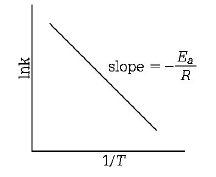
Compare the above equation $$w.r.t.$$ straight line equation of $$y = mx + c.$$ Thus, if a plote of $${\text{ln}}\,k\,\,{\text{vs}}\,\frac{1}{T}$$ is a straight line, the validity of the equation is confirmed.
Slope of the line $$ = - \frac{{{E_a}}}{R}$$
Thus, measuring the slope of the line, the value of $${{E_a}}$$ can be calculated.
282.
For a reaction $$A + 2B \to C,$$ the amount of $$C$$ formed by starting the reaction with $$5\,moles$$ of $$A$$ and $$8\,moles$$ of $$B$$ is
A
5$$\,moles$$
B
8$$\,moles$$
C
16$$\,moles$$
D
4$$\,moles$$
Answer :
4$$\,moles$$
$$A + 2B \to C$$
$$1\,mole$$ of $$A$$ reacts with $$2\,moles$$ of $$B$$ to give $$1\,mole$$ of $$C.$$
∴ $$5\,moles$$ of $$A$$ would react with $$10\,moles$$ of $$B$$ to give $$5\,moles$$ of $$C.$$
But, only $$8\,moles$$ of $$B$$ are available
∴ $$B$$ acts as a limiting reagent.
$$2\,moles$$ of $$B$$ gives $$1\,mole$$ of C
∴ $$8\,moles$$ of $$B$$ will give $$\frac{1}{2} \times 8 = 4\,moles$$ of $$C.$$
283.
The slope in Arrhenius plot, is equal to :
A
$$ - \frac{{{E_a}}}{{2.303\,R}}$$
B
$$\frac{{{E_a}}}{R}$$
C
$$ - \frac{R}{{2.303\,{E_a}}}$$
D
$${\text{None of these}}$$
Answer :
$$ - \frac{{{E_a}}}{{2.303\,R}}$$
Arrhenius equation is given by
$$k = A{e^{ - \frac{{{E_a}}}{{RT}}}}$$
Taking log on both sides, we get
$$\log \,k = \log A - \frac{{{E_a}}}{{2.303RT}}$$
Arrhenius plot a graph between $$\log k$$ and $$\frac{1}{T}$$ whose slope is $$\frac{{ - {E_a}}}{{2.303R}}.$$
284.
For a first order reaction $$A → P,$$ the temperature $$(T)$$ dependent rate constant $$(k)$$ was found to follow the equation $$\log k = - \left( {2000} \right)\frac{1}{T} + 6.0.$$ The pre-exponential factor $$A$$ and the activation energy $${E_a}$$ ,respectively, are
A
$$1.0 \times {10^6}{s^{ - 1}}\,{\text{and}}\,9.2\,kJ\,mo{l^{ - 1}}$$
B
$$6.0{s^{ - 1}}\,{\text{and}}\,16.6\,kJ\,mo{l^{ - 1}}$$
C
$$1.0 \times {10^6}{s^{ - 1}}\,{\text{and}}\,16.6\,kJ\,mo{l^{ - 1}}$$
D
$$1.0 \times {10^6}{s^{ - 1}}\,{\text{and}}\,38.3\,kJ\,mo{l^{ - 1}}$$
285.
If $$60\% $$ of a first order reaction was completed in $$60\,\min, $$ $$50\% $$ of the same reaction would be completed in approximately $$\left( {{\text{log}}\,4 = 0.60,{\text{log}}\,5 = 0.69} \right)$$
286.
For a certain reaction a large fraction of molecules has energy more than the threshold energy, still the rate of reaction is very slow. The possible reason for this could be that
A
the colliding molecules could be large in size
B
the colliding molecules must not be properly oriented for effective collisions
C
the rate of reaction could be independent of the energy
D
one of the reactants could be in excess.
Answer :
the colliding molecules must not be properly oriented for effective collisions
Apart from energy considerations, the colliding molecules should have proper orientation for effective collisions.
287.
The unit of rate constant for the reaction, $$2{H_2} + 2NO \to 2{H_2}O + {N_2}$$
which has rate $$ = k\left[ {{H_2}} \right]{\left[ {NO} \right]^2},$$ is
A
$$mol\,{L^{ - 1}}\,{s^{ - 1}}$$
B
$${s^{ - 1}}$$
C
$$mo{l^{ - 2}}\,{L^2}\,{s^{ - 1}}$$
D
$$mol\,{L^{ - 1}}$$
Answer :
$$mo{l^{ - 2}}\,{L^2}\,{s^{ - 1}}$$
Unit of rate constant for the reaction is
$$\eqalign{
& k = \frac{{{\text{rate}}}}{{\left[ {{H_2}} \right]{{\left[ {NO} \right]}^2}}} \cr
& \,\,\,\, = \frac{{mol\,{L^{ - 1}}\,{s^{ - 1}}}}{{\left( {mol\,{L^{ - 1}}} \right){{\left( {mol\,{L^{ - 1}}} \right)}^2}}} \cr
& \,\,\,\, = mo{l^{ - 2}}\,{L^2}\,{s^{ - 1}} \cr} $$
288.
Half-life period of a first order reaction is $$10\,\min .$$ What percentage of the reaction will be completed in $$100\,\min ?$$
289.
A reaction proceeds by first order, $$75\% $$ of this reaction was completed in $$32\,\min .$$ The time required for $$50\% $$ completion is
A
$$8\,\min $$
B
$$16\,\min $$
C
$$20\,\min $$
D
$$24\,\min $$
Answer :
$$16\,\min $$
Given : 75% reaction gets completed in $$32\,\min $$
$$\eqalign{
& {\text{Thus,}}\,k = \frac{{2.303}}{t}{\text{log}}\frac{a}{{\left( {a - x} \right)}} \cr
& = \frac{{2.303}}{{32}}{\text{log}}\frac{{100}}{{\left( {100 - 75} \right)}} \cr
& = \frac{{2.303}}{{32}}{\text{log}}4 \cr} $$
\[=0.0433\,{{\min }^{-1}}\]
Now we can use this value of $$k$$ to get the value of time required for 50% completion of reaction
$$\eqalign{
& t = \frac{{2.303}}{k}{\text{log}}\frac{a}{{\left( {a - x} \right)}} = \frac{{2.303}}{{0.0433}}{\text{log}}\frac{{100}}{{50}} \cr
& = \frac{{2.303}}{{0.0433}}{\text{log}}\,2 = 16\,\min \cr} $$
290.
A reaction was found to be second order with respect to the concentration of carbon monoxide. If the concentration of carbon monoxide is doubled, with everything else kept the same, the rate of reaction will
A
increase by a factor of 4
B
double
C
remain unchanged
D
triple
Answer :
increase by a factor of 4
Since the reaction is 2nd order $$w.r.t$$ $$CO,$$ Thus, rate law is given as.
$$r = k{\left[ {CO} \right]^2}$$
Let initial concentration of $$CO$$ is a i.e. $$[CO]=a$$
$$\therefore \,\,{r_1} = k{\left( a \right)^2} = k{a^2}$$
when concentration becomes doubled, i.e.$$[CO] =2a$$
$$\therefore \,\,{r_2} = k{\left( {2a} \right)^2} = 4k{a^2}\,\,\,\therefore {r_2} = 4{r_1}$$
So, the rate of reaction becomes 4 times.