23.
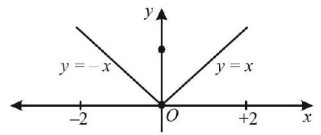
Let $$f(x) = \left\{ {_{1,}^{\left| x \right|,}} \right.\,_{{\text{for }}x = 0}^{{\text{for }}0 < |x| \leqslant 2}$$ then at $$x = 0,f$$ has
A
a local maximum
B
no local maximum
C
a local minimum
D
no extremum
Answer :
no extremum
It is clear from figure that at $$x = 0,f\left( x \right)$$ is not differentiable.
⇒ $$f\left( x \right)$$ has neither maximum nor minimum at $$x = 0.$$
24.
If the relation between sub-normal $$SN$$ and subtangent $$ST$$ at any point $$S$$ on the curve; $$b{y^2} = {\left( {x + a} \right)^3}$$ is $$p\left( {SN} \right) = q{\left( {ST} \right)^2},$$ then the value of $$\frac{p}{q}$$ is :
There is only one function in option (A) whose critical point $$\frac{1}{2} \in \left( {0,1} \right)$$ for the rest of the parts critical point $$0 \notin \left( {0,1} \right).$$ It can be easily seen that functions in options (B), (C) and (D) are continuous on [0, 1] and differentiable in (0, 1).
\[{\text{Now}}\,{\text{for}}\,f\left( x \right) = \left\{ {\begin{array}{*{20}{c}}
{\left( {\frac{1}{2} - x} \right),}&{x < \frac{1}{2}} \\
{{{\left( {\frac{1}{2} - x} \right)}^2},}&{x \geqslant \frac{1}{2}}
\end{array}} \right.\]
$$\eqalign{
& {\text{Here}}\,f'\left( {\frac{{{1^ - }}}{2}} \right) = - 1\,{\text{and}}\,f'\left( {\frac{{{1^ + }}}{2}} \right) = - 2\left( {\frac{1}{2} - \frac{1}{2}} \right) = 0 \cr
& \therefore f'\left( {\frac{{{1^ - }}}{2}} \right) \ne f'\left( {\frac{{{1^ + }}}{2}} \right) \cr
& \therefore f\,{\text{is not differentiable at }}\frac{1}{2} \in \left( {0,1} \right) \cr
& \therefore LMV{\text{ is not applicable for this function in}}\,\left[ {0,1} \right] \cr} $$
29.
If $$x\, \in \,\left[ { - 1,\,1} \right]$$ then the minimum value of $$f\left( x \right) = {x^2} + x + 1$$ is :
A
$$ - \frac{3}{4}$$
B
$$1$$
C
$$3$$
D
none of these
Answer :
none of these
$$\eqalign{
& {\text{Given, }}f\left( x \right) = {x^2} + x + 1 \cr
& f'\left( x \right) = 2x + 1 \cr
& f''\left( x \right) = 2 \cr
& {\text{For extrema of }}f\left( x \right) \cr
& f'\left( x \right) = 0 \Rightarrow x = - \frac{1}{2} \cr
& {\text{also }}f''\left( x \right) > 0 \cr
& {\text{Thus }}f\left( x \right){\text{ will achieve it's minima at }}x = - \frac{1}{2} \cr
& {\text{which is }}\frac{3}{4} \cr} $$
30.
If $$2a + 3b + 6c = 0,$$ then at least one root of the equation $$a{x^2} + bx + c = 0$$ lies in the interval
A
(1, 3)
B
(1, 2)
C
(2, 3)
D
(0, 1)
Answer :
(0, 1)
Let us define a function
$$f\left( x \right) = \frac{{a{x^3}}}{3} + \frac{{b{x^2}}}{2} + cx$$
Being polynomial, it is continuous and differentiable, also,
$$\eqalign{
& f\left( 0 \right) = 0\,{\text{and}}\,f\left( 1 \right) = \frac{a}{3} + \frac{b}{2} + c \cr
& \Rightarrow f\left( 1 \right) = \frac{{2a + 3b + 6c}}{6} = 0\,\left( {{\text{given}}} \right) \cr
& \therefore f\left( 0 \right) = f\left( 1 \right) \cr
& \therefore f\left( x \right)\,{\text{satisfies all conditions of Rolle}}\,{\text{theorem}}\,{\text{therefore}}\,f'\left( x \right) = 0\,{\text{has a root in}}\left( {{\text{0,1}}} \right) \cr
& {\text{i}}{\text{.e}}{\text{.}}\,a{x^2} + bx + c = 0\,{\text{has at lease one root in }}\left( {{\text{0,1}}} \right) \cr} $$