Application of Derivatives MCQ Questions & Answers in Calculus | Maths
Learn Application of Derivatives MCQ questions & answers in Calculus are available for students perparing for IIT-JEE and engineering Enternace exam.
41.
Let $$x$$ be a number which exceeds its square by the greatest possible quantity. Then $$x$$ is equal to :
A
$$\frac{1}{2}$$
B
$$\frac{1}{4}$$
C
$$\frac{3}{4}$$
D
none of these
Answer :
$$\frac{1}{2}$$
$$y = x - {x^2}$$ where $$y$$ is the greatest difference.
$$\eqalign{
& \frac{{dy}}{{dx}} = 1 - 2x \cr
& \therefore \frac{{dy}}{{dx}} = 0 \Rightarrow x = \frac{1}{2} \cr} $$
Again, $$\frac{{{d^2}y}}{{d{x^2}}} = - 2$$
$$\therefore \,y$$ is the maximum at $$x = \frac{1}{2}$$
42.
Let $$f\left( x \right) = {\left( {x - p} \right)^2} + {\left( {x - q} \right)^2} + {\left( {x - r} \right)^2}.$$ Then $$f\left( x \right)$$ has a minimum at $$x = \lambda ,$$ where $$\lambda $$ is equal to :
A
$$\frac{{p + q + r}}{3}$$
B
$$\root 3 \of {pqr} $$
C
$$\frac{3}{{\frac{1}{p} + \frac{1}{q} + \frac{1}{r}}}$$
43.
The slope of the tangent to the curve $$y = \sqrt {4 - {x^2}} $$ at the point where the ordinate and the abscissa are equal, is :
A
$$-1$$
B
$$1$$
C
$$0$$
D
none of these
Answer :
$$-1$$
Here $$y > 0.$$ Putting $$y=x$$ in $$y = \sqrt {4 - {x^2}} ,$$ we get $$x = \sqrt 2 ,\, - \sqrt 2 $$
So, the point is $$\left( {\sqrt 2 ,\,\sqrt 2 } \right)$$
Differentiating $${y^2} + {x^2} = 4$$ w.r.t. $$x,$$
$$\eqalign{
& 2y\frac{{dy}}{{dx}} + 2x = 0\,\,\,\,\,\,\,{\text{or, }}\frac{{dy}}{{dx}} = - \frac{x}{y} \cr
& \therefore \,{\text{ at }}\left( {\sqrt 2 ,\,\sqrt 2 } \right),\,\frac{{dy}}{{dx}} = - 1 \cr} $$
44.
Let $$f\left( x \right) = \cos \,\pi x + 10x + 3{x^2} + {x^3},\, - 2 \leqslant x \leqslant 3.$$ The absolute minimum value of $$f\left( x \right)$$ is :
45.
If at each point of the curve $$y = {x^3} - a{x^2} + x + 1,$$ the tangent is inclined at an acute angle with the positive direction of the $$x$$-axis, then :
48.
The angle between two tangents to the ellipse $$\frac{{{x^2}}}{{16}} + \frac{{{y^2}}}{9} = 1$$ at the points where the line $$y=1$$ cuts the curve is :
49.
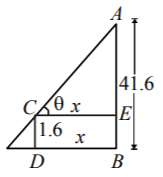
A man is moving away from a tower $$41.6\,m$$ high at a rate of $$2\,m/s.$$ If the eye level of the man is $$1.6\,m$$ above the ground, then the rate at which the angle of elevation of the top of the tower changes, when he is at a distance of $$30\,m$$ from the foot of the tower, is :
A
$$ - \frac{4}{{125}}\,rad/s$$
B
$$ - \frac{2}{{25}}\,rad/s$$
C
$$ - \frac{1}{{625}}\,rad/s$$
D
none of these
Answer :
$$ - \frac{4}{{125}}\,rad/s$$
Let $$CD$$ be the position of man at any time $$t.$$
Let $$BD$$ be $$x.$$
Then $$EC = x.$$
Let $$\angle ACE$$ be $$\theta $$
Given $$AB = 41.6\,m,\,CD = 1.6\,m,{\text{ and }}\frac{{dx}}{{dt}} = 2{\text{ }}m/s.$$
$$AE = AB - EB = AB - CD = 41.6 - 1.6 = 40\,m$$
We have to find $$\frac{{d\theta }}{{dt}}$$ when $$x = 30\,m$$
From $$\Delta AEC,\,\tan \,\theta = \frac{{AE}}{{EC}} = \frac{{40}}{x}$$
Differentiating w.r.t. to $$t,$$
$$\eqalign{
& {\sec ^2}\theta \frac{{d\theta }}{{dt}} = \frac{{ - 40}}{{{x^2}}}\frac{{dx}}{{dt}} \cr
& {\text{or }}{\sec ^2}\theta \frac{{d\theta }}{{dt}} = \frac{{ - 40}}{{{x^2}}} \times 2 \cr
& {\text{or }}\frac{{d\theta }}{{dt}} = \frac{{ - 80}}{{{x^2}}}{\cos ^2}\theta \cr
& {\text{or }}\frac{{d\theta }}{{dt}} = - \frac{{80}}{{{x^2}}}\frac{{{x^2}}}{{{x^2} + {{40}^2}}} \cr
& {\text{or }}\frac{{d\theta }}{{dt}} = - \frac{{80}}{{{x^2} + {{40}^2}}} \cr} $$
When $$x = 30\,m,\,\,\,\frac{{d\theta }}{{dt}} = - \frac{{80}}{{{{30}^2} + {{40}^2}}} = - \frac{4}{{125}}\,rad/s.$$
50.
What is the slope of the tangent to the curve $$y = {\sin ^{ - 1}}\left( {{{\sin }^2}x} \right)$$ at $$x = 0\,?$$